
Space Man
a short story

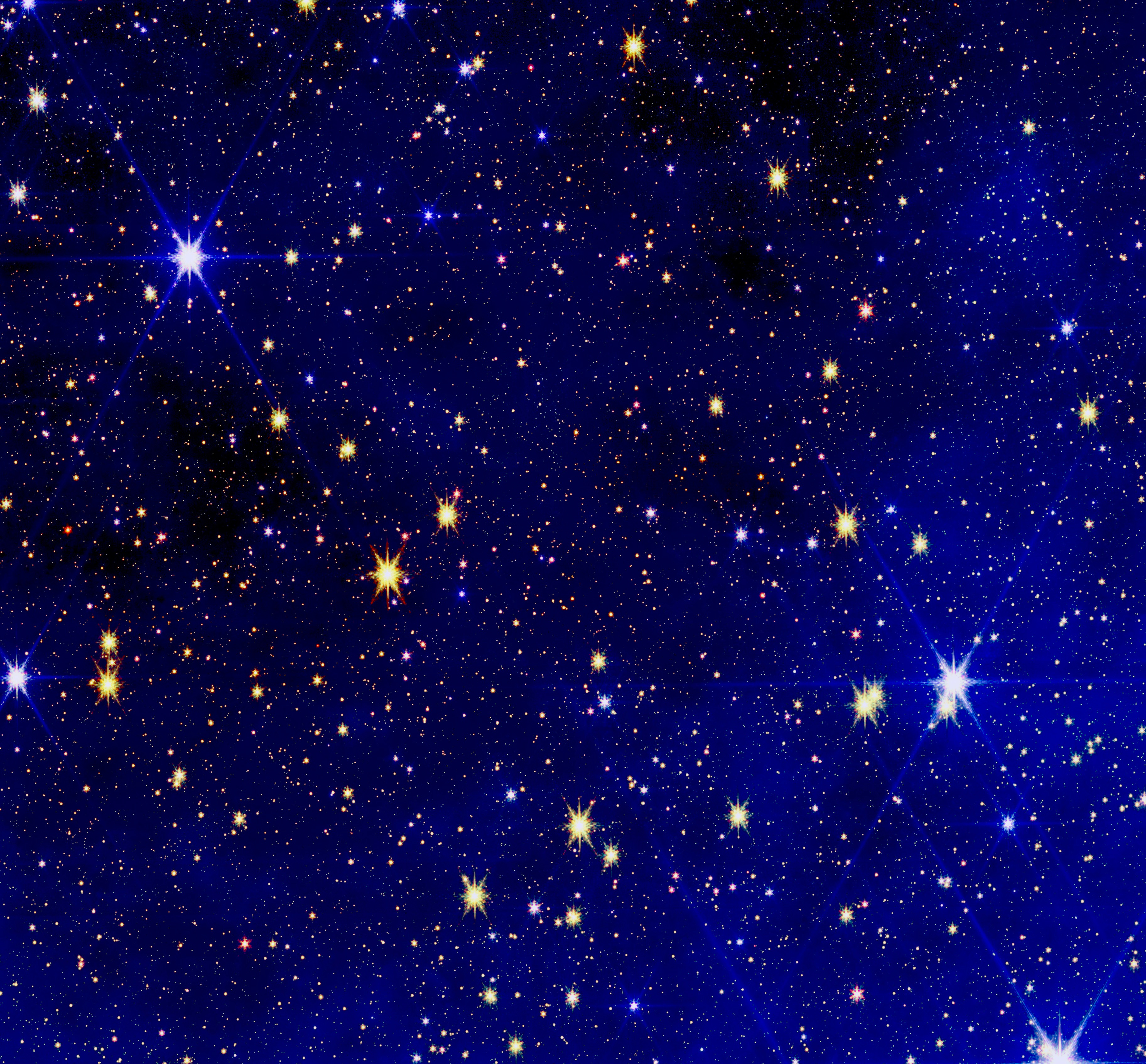
Twinkle, twinkle, little star does not apply here, where stars do not twinkle and are anything but little. Here, they shine as big, colorful, constant points of light, the power of which can be felt viscerally as one stares with clear mind. Countless stars, each representing multiple worlds, speckle the black background, while distant galaxies hide in the depth. Constant beams of red, orange, gold, blue, colors perhaps not seen on Earth – new, fantastic colors.
The endlessly incredible scene is visible only to him, for there is no one else here. It is an entire galaxy, and galaxies beyond, placed here for his viewing enjoyment, and for him to receive information, for they are not just sources of light and gravity, but of information. Of this, he is certain. But how to process the information, that is the question. Rudolf floats weightless and motionless as he stares. He has made his mind an empty vessel to be filled with whatever information the stars provide. The information he hopes for, but the bliss he feels, and it fills his being. Pure mind flows in and out and merges with the infinite. What could be better?
As Rudolf stares out into the boundless depth of space, his deep state of meditation is interrupted by thoughts of just how far he is from Earth. These thoughts slip into his consciousness as a positive sense of ultimate solitude, then take the form of mathematic considerations. His mind attempts to fathom the distance, but the distance is so great that he finds it inconceivable to think of it in anything but the time it takes to travel from here and there, and from there to here, and why is it the same? Five billion miles makes no sense, but the enormous distance gives Rudolf a feeling of accomplishment. To simply be here is a great adventure worthy of the annals of history – worthy of song, or so it would have been in ancient times. These thoughts mark the end of his meditation, but it ends this way, as it often does, with a smile and a sense of peace and fulfilment.
Rudolf’s chores for the day are over, and he thinks about reading a book, but the view of the stars never gets old, and really, the day never ends here. The amount of light never changes. It’s like being stuck in time, somewhere perpetually between night and day. The positions of the stars never change. Only the planets move relative to the ship, and they move at an imperceptible pace. From this window, he can’t even see them, as it faces away from the sun and the planets of his solar system. The vista is still, it is quiet, and it is peaceful beyond anything he ever hoped for.
After staring and contemplating time and distance for some unknown amount of time, he reaches out to the window and gently pushes himself back. Rudolf does a slow somersault in the air and drifts into the cylindrical corridor. He pulls once on the ladder on the ceiling and glides through the center of the corridor like a slow human missile. He has practiced this a thousand times, and he appreciates the symmetry of his path as he floats in outer space, confined within the Galaga-17 station, just beyond the Kuiper Belt.
Galaga has been his home since March 17, 2088. It is now July 17, 2089. He has been alone for sixteen months. Rudolf Fentz was chosen for the mission because of his ability to spend time alone. He was happy to be chosen, and he is still happy to be here. He almost regrets the coming end of his mission.
In three weeks, a ship with his replacement will leave Earth. In another three months, it will arrive at Galaga. Another astronaut will replace him and he will transfer to Earth’s moon for one week of rehab in one-sixth Earth gravity before returning to Earth, where he will be back in full gravity. After being weightless for nearly two years, astronauts have a hard time re-adapting to gravity. Rudolf is not looking forward to it. Zero-G suits him. Rudolf finds nothing is more relaxing than floating weightless, not touching anything, and gazing out a window at space. It’s easy to imagine he is floating in space, and he is, only doing so within a system which ensures his survival in this place where no man was meant to be, a bubble of air enclosed by the Galaga-17 space station.
Rudolf navigates through the station to the comm room. He comes here twice a day to check for messages and read the news from earth. This is his lifeline to humanity, without which his solitude would, perhaps, descend into loneliness – the thought has crossed his mind. Though the communication is restricted to text, his twice-daily correspondence is a part of his routine that he always looks forward to.
But the news has been depressing lately. His country, the Peoples Republic of Eastern Europe, has been beset with political instability. The president and everyone in his cabinet have been accused of various schemes of corruption. Even the director of the space program is involved. Rudolf is glad to be separated from all that, but it brings upon him an ominous shade of vulnerability when he thinks about it.
Up here, in space, he is totally reliant on Earth, his country, and his space program. But on a daily basis, besides the correspondence, he needs nothing from anyone, so the worries go as quickly as they come, evaporating into the emptiness of space when he stares out the window.
Today, the news is much worse than usual. The head of the space program has been deposed, and Ben Jalkstrom has taken his place. Ben and Rudolf were classmates in university, and though they were once friends, they took opposing political stances and fell out with each other. Now, in addition to gravity, Rudolf will have to face subordination to Ben, and Ben will not likely make Rudolf’s life easy. In fact, Rudolf wonders if Ben will fire him immediately upon return.
No matter, he thinks, nothing will change today, or for the next seven months. He drifts through the station to the lounge, where he opens his e-reader and lays into a book about theoretical physics. In the last sixteen months, he has had plenty of time for reading, studying, and contemplating. Quantum physics intrigues him and draws him into an alternate universe where almost anything can happen – a universe where the laws of reality are different. He occasionally gets ideas when he reads, and he always follows them wherever they lead.
The news three days later is even worse. The Army has taken over the capital and arrested the president and all his cabinet. The top general has declared martial law and himself the interim president.
Each day is a new low for his country. In the following days, the general is deposed by another general, and this one gets assassinated by the resistance. The People’s Republic of Eastern Europe is falling apart.
Today’s headline reads, “RUSSCHINA INVADES.” Rudolf winces when he reads it. Modern military conflicts rarely include invasions. This means that Russchina wants to annex Eastern Europe, and with the country in a state of chaos, this will probably happen.
He types a message to Space Control and awaits a response. None comes. He sends a message to Galaga mission director, then to the technical advisory team, to the mission doctor, the mission psychiatrist, and even the mission librarian. None respond. Rudolf sighs and speaks out loud.
“Looks like it’s just you and me buddy,” he says to himself.
He rarely talks to himself, but speaking to himself in the second person takes the edge off the sudden crushing sense of isolation. He is deep in space and reliant on a system that probably no longer exists.
Will the Russchinans take over the space program? He thinks they will. But when? They have more important things to deal with at the moment, like subjugating his country.
Food comes to mind. The station is always supplied with twice what it needs, so he should have plenty to last him through whatever delay will likely occur. Water is manufactured and solar power is constant, but there is no way to make food in space. Not on Galaga anyway.
His next thought is of relief from having to take orders from Ben. Who knows where Ben is, or if he is even still alive. But in the worst-case scenario, with no space program and no transport vessel, Rudolf knows he will have to go into hibernation before the food runs out. His mind tries to come up with a solution. But there are no plants onboard, no seeds, no soil, no grow lights, nothing with which he might cobble together a farm. He won’t die here, at least not for a very long time. But to submit to hibernation without a defined wake-up date would not be much different.
He looks out the window. Empty space. No soil out there either. No life whatsoever. Not even air. Rudolf skips dinner. Two years isn’t so long when it ends with indefinite hibernation.
The following day, he checks for messages. The screen remains empty. This is not so unexpected, but when he checks for the news and finds only yesterday’s “RUSSCHINA INVADES,” and thus no transmission at all since yesterday, he is stunned. The news is supposed to come through automatically. If it isn’t coming, this means that Space Control’s automated functions are offline. Space Control has been shut down. The worst-case scenario is becoming more likely.
For the first time in his adult life, Rudolf feels alone. It hits him like a sudden wave of fear. Being the only person around for long periods of time is easy, but being cut off completely from all of humanity is something new and serious. It feels like gravity, and he has not the strength to resist its pull, and it pulls him down. But there is no down as Rudolf floats equidistant from the four walls, none of which he considers the floor or the ceiling. Down, the direction the loneliness pulls him, is in all directions, as if his soul is leaking out of the station and he can do nothing to keep it in.
He finds solace in checking all the systems on Galaga. Everything is running smoothly. He has plenty of power, plenty of water, and the hibernation system checks out. He will survive, but he only wishes he could write with someone, even if it has to be Ben Jalkstrom. He cannot, so he reads.
Rudolf has been studying time and how it is distorted by black holes. The closer one gets to the event horizon, the slower time moves, as observed from far away. Time theoretically stops at the event horizon, but what about beyond, inside the black hole – would time reverse? He can’t help but think that if he could travel in time, he could escape this problem. Theoretically, this is possible, but no one has figured out how to do it.
The nearest black hole is over a thousand light years away. One thousand years to get there while traveling at the speed of light – completely and utterly impossible to travel from here to there in any sort of spaceship. Theoretically, anything slipping into a black hole would be destroyed anyway, pulled apart and atomized by the extreme differential of gravity.
Wormholes, on the other hand, should not have fatal gravity differentials and could exist anywhere. These, he discerns, are places in the fourth dimension where our third dimension overlaps, like folds in paper if we were living in a two-dimensional space. If he could find one and use it to return to Earth, he would not only be saved, but also immortalized in the annals of science. Perhaps someone would even write a song about him. He dives deeper into his studies.
Two months pass without correspondence, and Rudolf only sees “RUSSCHINA INVADES” whenever he looks, so he looks less often, at first only once a day, then every other day, and then only at odd intervals with many days in between. Instead of correspondence with Earth, he corresponds with the authors of the books and articles he studies. He imagines he is seeing inside their heads, and that they can see inside his, and information is exchanged between them. And he corresponds with the stars, opening his mind and receiving their secrets. He is getting better at this. Rudolph has plenty of time to think, and to read, and to draw diagrams, and to calculate.
He eats a little less each day, stretching his food supply. He moves more slowly. He recedes into his mind. This is where he will find salvation.
There has been no communication with Earth, or anywhere else, and he ceases to expect it. His country is gone, and so he feels no motivation to continue with his official responsibilities. The data he collects will be useless now. Instead, Rudolf studies and sketches diagrams and he thinks. He spends a lot of time thinking. He has nearly two years to come up with a solution.
Finding a wormhole is only the beginning. What to do when one is found is much more complicated. They are not simply tunnels leading from one region of space to another, but more like incompatibilities in space where moving to many other places almost instantaneously is possible, at least in theory.
It comes to him that stars and their gravity create reality, and the other stars we see are merely records of the past. All of our reality is within our solar system. At a region a certain distance from the star, where gravity is at a certain low related to Plank’s Constant, a continuous spherical wormhole should exist. This is in complete conjunction with Heisenberg’s Uncertainty Principle. It doesn’t just apply to quantum particles, but to our reality and location as well. The Kuiper Belt is just inside this region. It’s not a hole, it’s a horizon.
Galaga was not designed to travel, but the station can change its orientation or rotate with small thrusters. These thrusters, with only minor modification, should also be able to put her on a course. But velocity will be slow. No matter, he has the time and he gets to work.
Rudolf sets a course and puts Galaga in motion. It will take over a year to get there, but he is patient, and he has enough food. He continues calculating and studying. If he can travel through the horizon and navigate within, he might be able to get close enough to Earth to get home in the escape pod, which was designed to achieve reentry and terrestrial or marine landing.
A year passes. Contemplation in stillness dominates the non-reading part of his days. Time bends to his will in his own head. His consciousness moves close to the edge of time and dances on its periphery. Understanding the riddle is what he seeks, and to be on the edge of time is, he believes, to be on the edge of understanding.
He eats only half what he did before his country fell. Still there are no communications from Earth. Sometimes, he looks at Earth through a telescope, and it is but a tiny blue dot. Light from Earth travels the five billion miles in seven and a half hours and enters his pupils, and his mind. It’s almost like being there, seven and a half hours ago.
Seven months later, he almost has it worked out, but the solution has been right there all along. The other stars are so far away, he has calculated, because the space-time continuum folds right outside every star system. Just outside the Kuiper Belt. Right where he is. It is the gravity of stars that provide the three-dimensional space around them. The distance to the other stars is somewhat an illusion. The galaxy was probably designed this way to keep us home. To keep us separated from whoever else was out there. But he doesn’t want to go to another star, he wants to go home.
Rudolf finally works out a method to calculate position in five dimensions, and the maneuvers will be easier than he originally thought. Motion only happens in three dimensions. The fourth is time, and in the fifth, everything is still. Traveling through the wormhole to Earth is something he calculates with precision, and he repeats the calculation four times over the course of a week. Each time he gets the same results. He fires the thrusters and puts Galaga on a course.
Three months later, he is there. He sets Galaga in a spin and observes the instruments. Rudolf is strapped into a chair and he feels the g-forces of the spin. He has calculated and predicted that there is no gravity and will not be g-forces in the wormhole. The spin accelerates as Galaga-17 moves closer to the wormhole horizon. He is pulled deeper into the soft chair, and then, nothing. Floating again, yet still Galaga spins. Success! He moves on to the next phase of the plan. He has programmed all the maneuvers into the ship’s navigation hardware, and he sets it in motion.
Outside the window, the stars, which have been a constant anchoring-in-reality presence, now blur and fade and go out completely. In a flash they all come back swooping across the sky, as does the giant blue planet rolling underneath. The g-forces come back too, and Rudolf is sucked back into his chair.
He can barely shout “Eureka!” before an alarm sounds. The ship vibrates, slightly at first and then violently. He is too close. Galaga is entering Earth’s atmosphere. Rudolf fires the thrusters, trying to escape reentry, but they are far too weak. Galaga will be destroyed in seconds. She was designed to float in the calm and motionless void of outer space, and not for any sort of disruptive motion.
Rudolf has no time to grab anything. He holds on to the handholds along the walls and walks as quickly as possible to the escape pod. Inside, he straps in and pulls the lever marked with a red “GO!” and he goes.
The pod has no windows, but it knows what to do. It knows where it is and how to reenter Earth’s atmosphere. It knows when to deploy the parachute. Rudolf only hopes it all works, and as he hangs on to the seatbelts, he smiles as it sets in that he has made history. He has discovered how to travel through the wormhole and how to navigate outside the third dimension. He recognized the North American continent before realizing he had to abandon ship. But perhaps it was all a dream – it all happened so fast. His mind spins as if waking from an intense sleep.
Is he really in the escape pod? Yes. Is he really about to enter Earth’s atmosphere, five billion miles away from where he was moments ago? It doesn’t seem possible. Yet his calculations were real. Yes. He entered the wormhole and he is entering Earth’s atmosphere. It has to be. This is Earth, no doubt about it. He has made history and will be famous, as long as he survives. As long as anyone on Earth cares. For all he knows, the whole world could be at war, or already in a post-Armageddon situation.
The pod shutters and slams through turbulence. The temperature ramps up. Rudolf sweats and tries to control his breathing. Explosions outside rock the pod. Galaga is a fireball and is no more.
He holds the straps tight. At the sound of a pop, the pod jerks into deceleration. The parachute is deployed. Rudolf smiles. The pod cools and he is no longer sweating, only hoping for a terrestrial landing, which he knows is at best a one-in-three chance on Earth. Landing on the ocean would likely not end well, since no one is expecting him, and no one will come looking.
He is pondering this outcome when the pod slams into something solid. The impact is intense, but Rudolf is uninjured. A green light comes on. He releases the seatbelt. He reaches for the lever next to the green light. His arm is heavy, but he grasps the lever.
What will I see on the outside, he thinks. A war zone? A forest? A desert? The Arctic? A peaceful suburb? A crowd of amazed people?
He pulls himself up with much effort. He is back in one-G. Earth’s gravity. It feels like he is made of iron.
Rudolf pulls the lever and the door slowly opens to the outside. Water falls on him and his first thought is that he is about to sink, but no, it is just rain. And some sort of music. Old, analog, music, in the distance. Music played by people on real instruments with metal strings. Drums. Someone singing. How bizarre. At the pace of a sloth and with the effort of a man lifting heavy chains, he stands, leans against the pod’s opening and looks out.
People all around, muddy people, amazed people, naked people wide-eyed and gaping, laughing, singing, spinning. A naked woman approaches. Rudolf hasn’t seen a woman in over three years, and the sight of her, and her naked body enraptures him. She holds flowers out to Rudolf, and he takes them. The flowers feel heavy. They smell heavy, and sweet, and wonderful. She smiles big and wide. He smiles big and wide. She hugs him. Rudolf hugs her.
“Dose,” she says, and Rudolf thinks she is speaking Spanish. “Dos?” he says. “Dios? No. No soy Dio.” I am not God, he says, and laughs. What an odd homecoming.
She sticks her tongue way out. Rudolf sticks his out, imitating her actions as if trying to communicate with a person of a new and strange culture, and she touches his tongue with the tip of her finger. Something tiny is on his tongue. Is it food? It must be a North-American custom, so he swallows it.
The people rejoice as if this is the greatest thing they have ever seen. Do they know what he has done? Do they already know that he has traveled through a wormhole and navigated the fourth and fifth dimensions from outside the solar system back to Earth? Why wouldn’t they? News travels fast. Maybe he has been the subject of the news for the last two years. Maybe they all know. They must, because he is obviously a celebrity.
But where is he? These people are heathen. They speak another language, but of course they would. It is English, but not any dialect he is familiar with. Certainly not Western-European English, nor Australian English. But North America is a big country, and he has heard that it is full of different dialects. Regardless, these people obviously adore him, and so he steps carefully and slowly out of the pod. The gravity and the slippery surface are too much, and he falls to the ground.
Wet, slick mud that oozes through his fingers and green grass that smells like home suddenly dominate hisattention. Two smiling, shirtless, and filthy men help him up. They lift him to their shoulders and cheer. The other people laugh and cry and rejoice. They carry him toward more people, an enormous crowd in a field, as many people as the stars he stared at for three years, and a stage in the distance where the music comes from – the center of the galaxy.
The people around him know what he has done. They are chanting “space man!” and a crowd is gathering. The stage is coming in view. They are speaking English. Why did the woman say “dos?” They are not speaking Spanish, but English. Rudolf is confused, but a feeling of elation is rising within.
Rudolf recognizes the man on stage. He looks just like a performer from a century ago. This must be a reenactment. The man on stage looks like the artist he remembers from history. He is a black man with a big puffy hairdo and a headband. “Afro.” The word comes to him and he laughs. Naming a hairdo after a continent. But that is what they did, back then. The man with the afro wears long loose colorful clothing, so colorful it almost glows. Everything almost glows. The colors and the music merge and dance around the edges of everything. Hendrix. Jimi Hendrix, he remembers.
The Hendrix impersonator goes into another song. The men still carry Rudolf on their shoulders and he laughs again, long and loud and with childlike joy that is almost overwhelming. This must be his welcoming ceremony, a great celebration for his heroic return to Earth.
A wave of joy so big it doesn’t fit inside fills him and pours out, emanating from his skin, which tingles like the stars he left behind. He is a star, radiating information. They are all stars, sharing a common consciousness of love. The music fits the feeling. The rain feels wonderful. He and the enormous crowd have merged into one colorful mass of love and sound.
He taps the men on the shoulders and they set him down and hug him. People call him “Space Man” and a whole crowd hugs him, men and women, and at least half of them are naked. He takes off his clothes and dances with them, smiling and laughing, strengthened somehow. He dances like they do, swirling and swooping, and a naked woman takes him by the hand and leads him away from the crowd, and they make love in the wet grass while Jimi Hendrix plays Purple Haze on stage in a field in Max Yasgur’s dairy farm in Bethel, sixty miles southwest of Woodstock, New York.
Nice work, Paul!
Hmmmm. Its a great story. I don't fully understand the ending though. I feel like I'm missing something. Did he go back in time? Lol....
Maybe im supposed to be confused.